
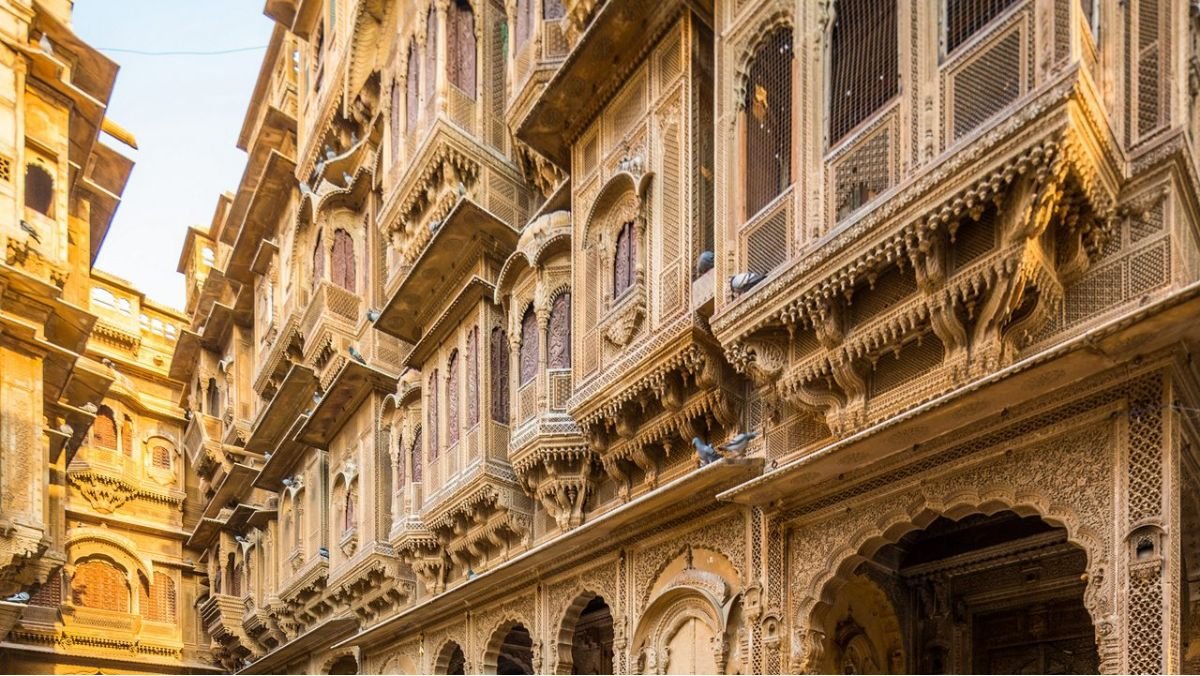
The skyline of the Golden City tells stories in sandstone, yet among its labyrinthine alleys, no residential structure commands attention quite like the cluster known as Patwon Ki Haveli. While Jaisalmer Fort anchors the horizon, Patwon Ki Haveli anchors the city’s rich mercantile legacy. It is not merely a single house; it is a five-story ensemble of five interconnected mansions that together encapsulate the pinnacle of Rajput-Mughal architectural finesse and sheer desert prosperity.
A Monument to Silk Route Prosperity
Understanding why Patwon Ki Haveli holds such authority requires stepping back into the early nineteenth century. Commissioned in 1805 by Guman Chand Patwa, a trader dealing in brocade, gold embroidery, opium, and banking, the complex took over fifty years to construct. Each of his five sons received an adjoining haveli, creating a continuous row of palaces whose facade is unmatched anywhere in Rajasthan.
During this era, Jaisalmer was an indispensable staging post along the trans-Thar caravan trails connecting northern India to Persia, Central Asia, and the Arabian Sea. The wealth that flowed through these trade arteries did not belong solely to the ruling bhatis; it rested squarely in the coffers of shrewd merchants. Patwon Ki Haveli stands as tangible proof of that commercial preeminence—a private home deliberately styled to rival royal palaces in grace and intricacy.
Architectural Supremacy in Yellow Sandstone
The true dominance of this haveli lies in the sheer level of craftsmanship etched into every inch of its locally quarried golden-yellow sandstone. Unlike common stone masonry, the work here resembles fine filigree or lace turned into stone.
- The Jharokhas: More than sixty carved balconies project outward across the facades. Each balcony is distinct, featuring intricate lattice patterns that allowed cool desert breezes to circulate inside while shielding the women of the household from the gaze of the busy street below.
- Interlocking Stone Construction: The master masons, known as the Silawats, constructed these multi-tiered residences largely without the use of mortar. Instead, blocks were cut to slot directly into one another using dry-stone interlocking joints, providing flexibility against desert tremors and heat expansion.
- Interior Wall Murals: While the exterior catches the golden afternoon light, the inner rooms preserve remnants of intricate miniature frescoes, gold-leaf motifs, and vibrant glass mirror-work imported from Europe, demonstrating the Patwa family’s vast global reach.
The Cultural Heart of the Walled City
Walking through Patwon Ki Haveli provides rare historical insight into the domestic rhythms of ancient Thar life. The architectural layout demonstrates sophisticated passive climate control. Thick walls keep ambient interior temperatures remarkably stable even when summer heat exceeds forty-five degrees Celsius. Central open-to-sky courtyards (chowks) serve as thermal regulators, drawing hot air upward and funneling cooler air through adjoining residential quarters.
Today, portions of the complex are managed by the Archaeological Survey of India (ASI) and house dedicated heritage galleries. Visitors can observe antique furniture, turbans, merchant account books, and artifacts that bring nineteenth-century domesticity vividly to life. It remains an irreplaceable cultural archive of the Thar Desert’s golden age.
Connecting Heritage with Desert Exploration
A complete journey through Jaisalmer bridges the architectural wonders of the old town with the vast, quiet wilderness of the surrounding Thar Desert. After spending a morning marveling at the meticulous stonework of the Patwas, travelers often head toward the open dunes to experience the desert’s natural grandeur firsthand.
Resting beneath the star-filled desert sky at a luxury camp in Jaisalmer allows travelers to unwind in comfort while retaining an authentic sense of place. The stark contrast between the dense, ornate carved corridors of the city’s havelis and the sweeping, quiet horizons of the dunes provides the complete story of western Rajasthan.
For those seeking adrenaline alongside heritage discovery, pairing cultural walks with Jaisalmer adventure activites—such as dune bashing, quad biking, and sunset camel safaris—creates a well-rounded itinerary. Experiencing both the historic architecture of Patwon Ki Haveli and the living desert landscape ensures an unforgettable encounter with the true spirit of Jaisalmer.


