
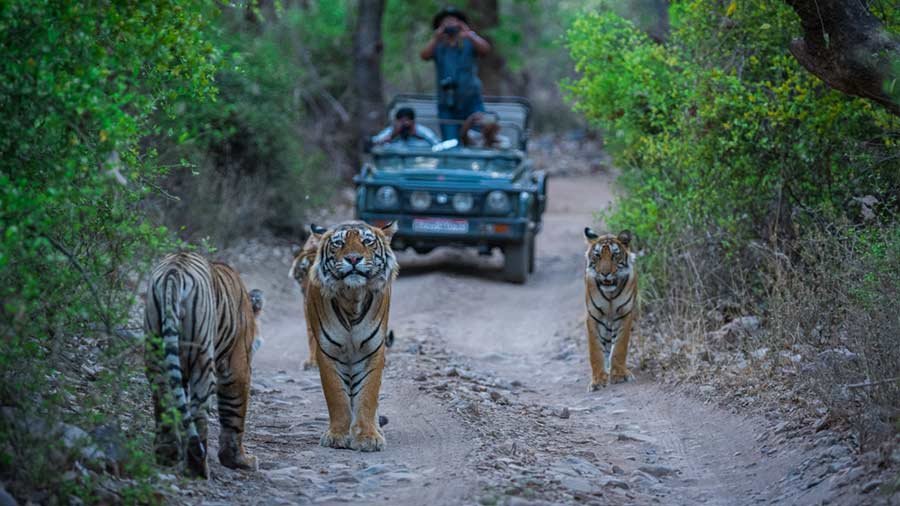
Encountering the Royal Bengal tiger in its natural habitat stands among the most exhilarating wildlife adventures on the planet. Across India’s vast wilderness corridors, specialized reserves protect these apex predators while offering travelers authentic wildlife expeditions. Drawing on extensive field observations and wildlife guiding insights, this comprehensive guide highlights premier reserves, practical safari planning strategies, and key conservation habitats.
Ranthambore National Park, Rajasthan
Set against the rugged backdrop of the Aravalli and Vindhya ranges, Ranthambore is internationally recognized for daylight predator sightings and dramatic historical ruins. The park surrounds the ancient 10th-century Ranthambore Fort, where ancient hunting pavilions, banyan trees, and crumbling stone arches create an unmistakable setting for wildlife tracking.
Tigers here have adapted to open dry deciduous scrub and lake edges. Lakes such as Padam Talao, Rajbagh, and Malik Talao serve as vital watering holes where dominant tigers frequently stalk chital and sambar deer. Exploring an assigned Ranthambore safari zone provides travelers with regulated access to distinct forest landscapes, balancing visitor impact while maximizing tracking opportunities.
Planning your expedition around climatic patterns is essential for wildlife movement. Determining the best time to visit Ranthambore ensures optimal track visibility and active waterhole congregation, typically between October and June before the annual monsoon closures begin. After dynamic morning and evening drives across the buffer and core sectors, staying at the best resort in Ranthambore offers naturalists and photography enthusiasts comfortable amenities, authentic Rajasthani hospitality, and proximity to entry gates.
Jim Corbett National Park, Uttarakhand
Established in 1936 as Hailey National Park, Jim Corbett holds distinction as India’s oldest national reserve and the birthplace of Project Tiger. Located in the Himalayan foothills of Nainital and Pauri Garhwal districts, this park encompasses broad valleys, moist deciduous sal forests, and the perennial Ramganga River.
Corbett’s varied geography creates distinct microclimates supporting diverse fauna:
- Dhikala tourism zone features expansive alluvial grasslands known as chaurs, favored by breeding tiger populations and wild elephant herds.
- Bijrani zone showcases mixed vegetation along sandstone ridges where big cats often traverse dry riverbeds.
- Jhirna zone remains open throughout the year, presenting consistent birdlife observation alongside mammalian tracking.
The Ramganga reservoir attracts vast numbers of migratory waterfowl alongside marsh crocodiles and fish-eating gharials, making game drives through Corbett an immersive multi-species safari.
Bandhavgarh National Park, Madhya Pradesh
Nestled within the Umaria district of central India, Bandhavgarh National Park boasts one of the highest known tiger densities in the wild. Historically maintained as a private game preserve for the Maharajas of Rewa, this landscape centers around a 2,000-year-old hilltop fort surrounded by bamboo thickets and sal woods.
Field naturalists favor Bandhavgarh due to relatively compact safari zones that increase tracking efficiency:
- Tala zone features steep rocky cliffs, historical caves, and perennial streams.
- Magdhi zone contains open grasslands and man-made water bodies that attract prey species during peak heat.
- Khitauli zone offers dense forest canopies favored by sloth bears, leopards, and territorial tigers.
The high concentration of prey—principally spotted deer, barking deer, and wild boar—sustains stable resident tiger families, allowing wildlife researchers and guided visitors regular opportunities to observe territorial scent-marking and hunting behavior.
Kanha National Park, Madhya Pradesh
Spanning the Maikal range of the Satpuras, Kanha National Park represents one of central India’s largest and most meticulously managed conservation areas. Its sweeping sal forests and expansive meadows provided visual inspiration for classic jungle literature, while its intensive conservation efforts famously brought the southern swamp deer (hardground barasingha) back from the brink of extinction.
Kanha operates on strict rotational zoning models to ensure ecological integrity:
- Kanha zone encompasses the central meadows where extensive herds graze alongside patrolling predators.
- Kisli zone features dense evergreen woodland suitable for nocturnal and crepuscular animal movement.
- Mukki zone provides panoramic access to river valleys where female tigers frequently raise cubs.
- Sarhi zone showcases dry deciduous hills punctuated by seasonal waterholes and raptor nesting sites.
The park authority maintains rigorous tracking standards, utilizing trained forest department elephants and seasoned local naturalists to track fresh pugmarks and distress alarm calls emitted by langurs and chital.
Tadoba-Andhari Tiger Reserve, Maharashtra
Often called the “Jewel of Vidarbha,” Tadoba-Andhari is Maharashtra’s oldest and largest national park. The reserve consists of the Tadoba National Park and the Andhari Wildlife Sanctuary, centered around dominant teak forests and bamboo undergrowth.
Tadoba’s sustained water availability via Tadoba Lake, Kolsa Lake, and the Erai River ensures reliable animal movement even during arid summer periods. The reserve gained international acclaim among wildlife documentarians due to high cub survival rates and consistent sightings around perennial marshlands. Safaris conducted via Moharli, Kolara, and Navegaon gates grant direct observation of active predator territories, sloth bears, wild dogs (dholes), and rich central Indian avian communities.
Essential Safari Etiquette and Planning Practices
Responsible wildlife tourism directly supports local habitat preservation and anti-poaching operations. To maximize safari safety and ethical standards, keep the following guidelines in mind:
- Reserve safari permits well in advance, as park authorities strictly limit daily vehicle quotas per zone to prevent vehicular congestion.
- Adhere strictly to assigned safari tracks and speed regulations established by the state forest department.
- Maintain absolute silence during predator approaches to avoid altering natural foraging or parenting routines.
- Wear neutral bush clothing such as khaki, olive, or beige to blend seamlessly into deciduous forest surroundings.
- Support designated eco-tourism initiatives and local community guides whose generational forest tracking skills remain vital to successful, conservation-minded expeditions.


