Jaipur, the vibrant capital of Rajasthan, captivates travelers with its terracotta-pink facades, towering hilltop forts, and storied royal heritage. Founded in 1727 by Maharaja Sawai Jai Singh II, the city is a masterclass in Rajput town planning, blending ancient Vedic architecture with rich cultural traditions. Spending 48 hours here allows you to immerse yourself in royal history, architectural marvels, and authentic Rajasthani hospitality. Partnering with a reliable tour operator in Rajasthan ensures a well-paced experience, seamlessly handling local transit, ticketing, and expert storytelling across the city’s key landmarks.
Day 1: Royal Palaces, Astronomical Marvels, and Fortified Heights
Morning: Hawa Mahal, City Palace, and Jantar Mantar
Begin your morning at sunrise in front of the iconic Hawa Mahal (Palace of Winds). Built in 1799 by Maharaja Sawai Pratap Singh, this five-story structure features 953 intricately carved jharokhas (small casements) designed to allow royal women to observe street festivities unobserved while enjoying cool air currents. Viewing the facade in early morning light offers the best photography conditions before city traffic builds.
A short walk through the old city gates leads to the City Palace complex, which remains the ceremonial seat of the Maharaja of Jaipur. The palace blends Rajput, Mughal, and European architecture. Key sections include the Mubarak Mahal, the Chandra Mahal, and the Diwan-i-Khas, home to two massive sterling silver vessels recorded in the Guinness World Records.
Adjacent to the palace stands Jantar Mantar, a UNESCO World Heritage site housing nineteen architectural astronomical instruments completed in 1734. The collection features the world’s largest stone sundial, the Vrihat Samrat Yantra, which measures local solar time with an accuracy of two seconds. Booking a guided jaipur full day tour helps you navigate these monuments with direct insights into their mathematical and historical significance.
Afternoon: Jal Mahal and Amber Fort
Head north toward the Amer region, stopping briefly at the banks of Man Sagar Lake to view Jal Mahal (Water Palace). This symmetrical red sandstone palace appears to float on the lake, with four of its five stories submerged beneath the water surface.
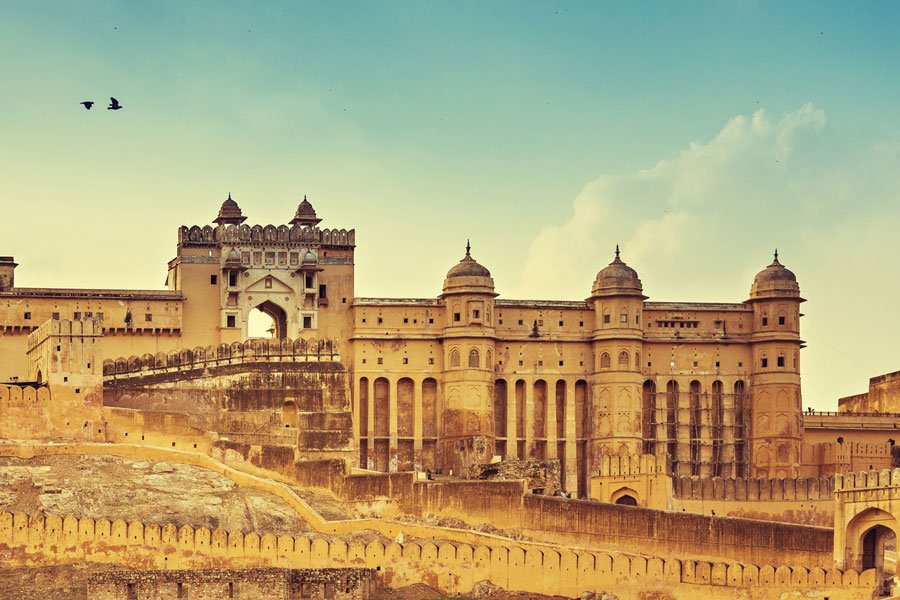
Continue upward to the imposing Amber Fort, situated atop Cheel ka Teela (Hill of Eagles). Constructed primarily from yellow and pink sandstone by Raja Man Singh I in the late 16th century, Amber Fort showcases opulent halls, expansive courtyards, and advanced defensive architecture. Must-see areas inside include:
- Sheesh Mahal (Mirror Palace), adorned with concave Belgian mirror tiles that illuminate the entire chamber with single-source candlelight
- Diwan-e-Aam (Hall of Public Audience), featuring double rows of columns topped with sculpted elephant capitals
- Sukh Niwas (Hall of Pleasure), designed with early evaporative cooling water channels
- Zenana Courtyard, the private royal women’s quarters featuring secluded interior passages
Evening: Sunset at Nahargarh Fort
Conclude your first day by traveling up the Aravalli ridge to Nahargarh Fort. Built in 1734 to bolster the city’s defense network, the fort offers sweeping panoramic views over the Jaipur cityscape. Watching the sun set over the glowing pink skyline provides a memorable perspective on the city’s geographic layout.
Day 2: Heritage Stepwells, Ancient Astronomy, and Bustling Bazaars
Morning: Panna Meena Ka Kund and Jaigarh Fort
Start your second day exploring Panna Meena Ka Kund, an eight-story 16th-century stepwell located near Amber Fort. Built for rainwater harvesting and community gatherings, its crisscross geometric staircases reflect indigenous engineering expertise.
Proceed next to Jaigarh Fort, perched directly above Amber. Known as the Victory Fort, Jaigarh never fell in battle and housed one of India’s most advanced medieval foundries. The central highlight is the Jaivana Cannon, manufactured in 1720 on-site, which was the world’s largest cannon on wheels at the time of its casting.
Afternoon: Albert Hall Museum and Royal Gaitor
Descend into the southern city to visit the Albert Hall Museum, situated in Ram Niwas Garden. Functioning as the central museum of Rajasthan, this Indo-Saracenic building was designed by Sir Samuel Swinton Jacob and opened in 1887. The museum houses rare collections of miniature paintings, Persian carpets, ivory carvings, and metal artifacts.
Afterward, visit the Royal Gaitor Tushar, the serene royal cenotaphs of the Kachwaha Maharajas tucked in a valley beneath Nahargarh. The delicate marble chattris (domed pavilions) feature intricate stone carvings honoring past rulers, offering a quiet contrast to the bustling city center. Travelers seeking to extend their journey across neighboring heritage destinations like Pushkar, Ajmer, or Ranthambore often opt for comprehensive jaipur three days tours to explore deeper into the desert state.
Evening: Bazaars of the Walled City
Wrap up your 48-hour itinerary by exploring the historic markets of the Pink City. Johari Bazaar offers world-renowned Kundan-Meena jewelry and precious gemstones, while Bapu Bazaar is the go-to destination for authentic Mojari leather footwear, blue pottery, and traditional Sanganeri block-printed textiles. Take time to sample authentic local dishes like Dal Baati Churma, Pyaaz Kachori, and Ghevar to end your Jaipur expedition with the true culinary flavors of Rajasthan.